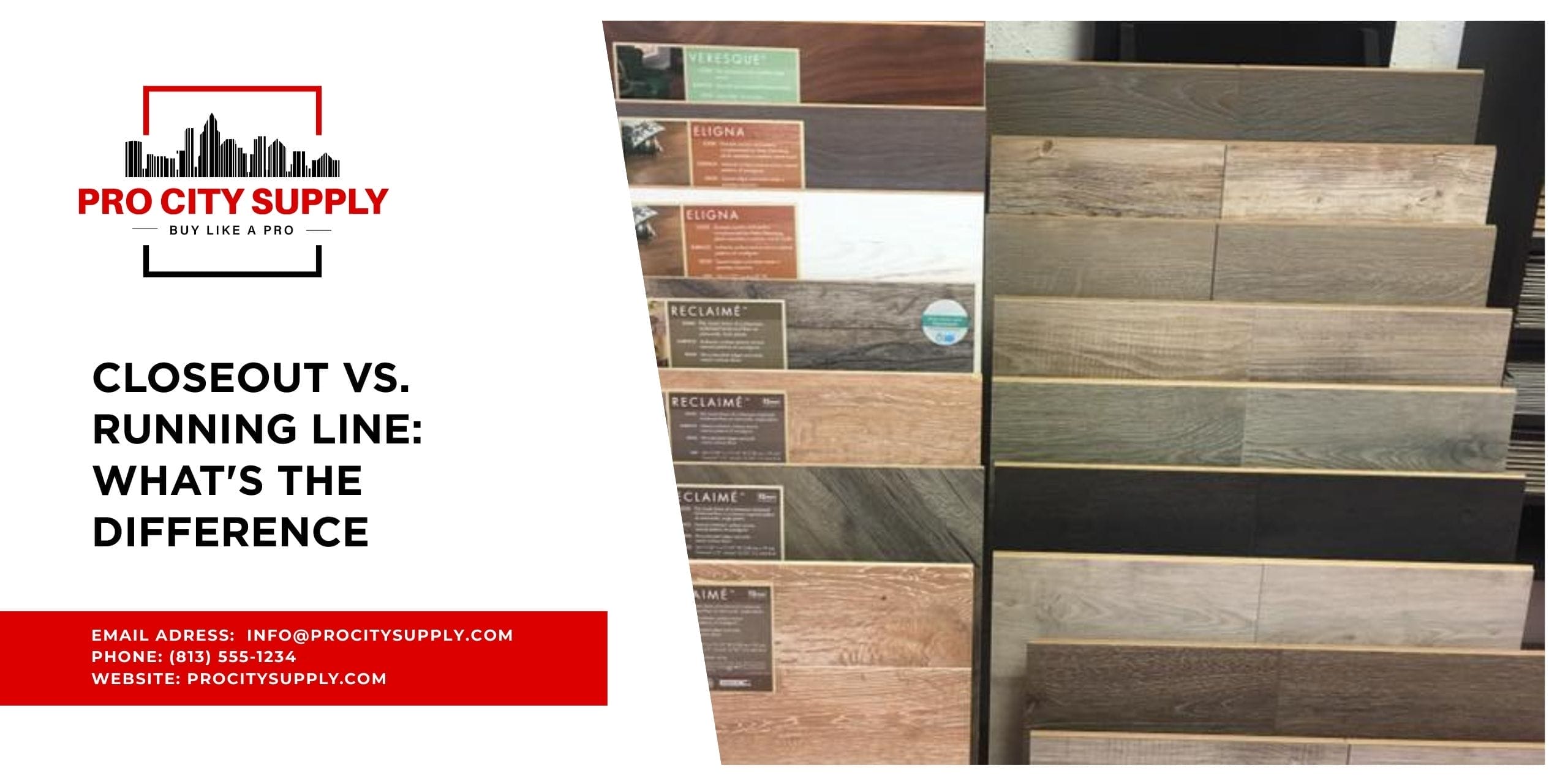
Closeout vs. Running Line: What’s the Difference?

closeout flooring vs running line

If you’ve ever shopped for flooring, you’ve probably come across two types of products: closeouts and running lines. At first glance, the differences seem minor. However, both can impact your project budget, timeline and how the floors you install look years from now.

Florida contractors know when to grab a closeout deal and when a running line product makes more sense. Homeowners, on the other hand, may wonder which one is the smarter choice.

At Pro City Supply, we help customers in Tampa and Orlando understand these options so they can buy like a pro at our flooring stores in Tampa and Orlando. With us, there’s no second guessing. Let’s walk through the differences to help you decide which one makes the most sense for your project.

What is Closeout Flooring (and Why Does It Exist)?

Closeouts are flooring products sold at steep discounts for one of two reasons. The most common is that they are no longer being produced and the other is that they are being cleared out by the manufacturer or distributor.

There are a few reasons why a product becomes a closeout:

  • The manufacturer discontinued the color or style
  • A new version or updated design has replaced it
  • There is excessive inventory from a previous production run
  • A supplier or retailer is clearing space for new stock

What’s the biggest benefit of closeouts? You get deep savings that range from 20% to 60% depending on the product. However, the limitation is: once it’s gone, it’s gone. 

When are closeouts useful? They’re more commonly used for projects where:

  • You don’t need flooring later
  • You’re working a single room
  • You’re flipping a home or upgrading a rental
  • Your client wants a great look on a tight budget

At our flooring and building supply store in Tampa, our closeouts move fast. Additionally, our team helps you confirm the exact square footage you’ll need so you don’t run short.

What is Running Line Flooring?

Running line refers to regularly stocked products that are currently in production by the manufacturer. These materials are part of the ongoing collection and are readily available.

Running line flooring provides:

  • Easy reordering if you need more now or in the future
  • Consistent inventory availability
  • Long-term matching ability for multi-room installs
  • Smoother warranty claims and manufacturer support

When should you use running products? They are best for:

  • Multi-room renovations
  • New construction
  • Projects completed in phases
  • Homes where future matching may be necessary

At our flooring and building material supply store in Orlando, we stock high-demand running line products in our showroom, including SPC, laminate, tile, engineered hardwood, trims, doors and installation tools. If contractors rely on it, we carry it.

Closeout vs. Running Line: How to Choose

Both closeouts and running line products can work for your project. The key is choosing the product based on your project needs. Let us simplify things with a basic comparison.

Choose closeouts if you’re after:

  • The best deal possible
  • A stylish upgrade on a budget
  • Flooring for a single room
  • Inventory that’s ready to install immediately

Closeouts are ideal for rentals, flips, guest rooms, small renovations and budget-sensitive homeowners. 

Opt for running line if your project requires:

  • Flooring across multiple rooms
  • Guaranteed future availability
  • A long-term investment
  • Flooring that will stay consistent for years

Running lines make sense for primary living spaces, open-concept layouts, higher-end renovations and long-term homes. 

Common Mistakes to Avoid When Shopping for Materials

Your flooring choice is a long-term decision. That’s why you have to be careful what you buy. Avoid the following pitfalls:

  • Not Checking Quantity: Closeouts require precise measurements, which means you can’t buy more later. 
  • Mixing Too Many Styles in One Space: The home will feel disjointed.
  • Assuming All Closeouts Are Clearance Problems: The majority of products are simply discounted, not defective.
  • Buying Running Line When You Don’t Need It: There’s no need to spend more than necessary.
  • Not Buying Extra for Repairs: Be sure to purchase additional materials, especially if you choose closeouts.

Need some tips? Let the Pro City Supply team help prevent you from making these mistakes before you buy.

Buy Smarter. Buy Like a Pro.

Closeout and running line products both have their place. When you choose the right one, you can save money, headaches and future replacements. How do you make the right choice for your project and buy your flooring like a pro?? Turn to the team at Pro City Supply. We’ll guide you in the right direction so you can get out of the showroom and back on the job site even sooner.

Want to compare your options? Contact us or visit our Tampa or Orlando showroom today!

Latest Posts

Not all flooring is priced low for the same reason. What looks like a deal can turn into a nightmare three months into a job. Some look expensive, but are more than what you need. What’s the difference between cheap flooring and value flooring? It’s one of the valuable things anyone working in the industry or buying flooring can learn. Whether you're a contractor, homeowner or a flipper, trying to hit your number without cutting corners can hurt you later. Let’s get into what drives flooring prices and where the real cost shows up. What Makes Flooring Cheap in the First Place? Flooring prices are determined by several factors. The most common ones include: Wear Layer Thickness: The wear layer is the protective coating on top of SPC and LVP flooring. Budget products are 6 mil or less. Professional-grade products start 12 mil and go up. Durability makes a difference over time. Core Construction: A thin or unstable core will cause the floor to flex, shift or telegraph subfloor imperfections. Quality SPC cores are denser, heavier and more dimensionally stable. Finish Quality: Cheaper products have a lower-grade UV coating, this shows wear faster and is harder to clean without dulling. Certifications and Testing: Reputable products have FloorScore, GREENGUARD or similar certifications. Budget flooring doesn’t usually have these and clients need to know when they ask. Where It’s Sourced: Direct-from-manufacturer pricing gives you a better product for a lower price. When a product passes through two or three distributors before reaching a store shelf, you’re paying for that chain. Cheap flooring isn’t always bad. It’s just important to know what you’re buying and where it’s going. When Does Cheap Flooring Cost You More? It’s easy to choose cheap flooring because of the low upfront costs. However, it’s also easy to get burned. Here’s an overview: For Contractors When a floor fails right away, you get an angry callback. This can cost you time, materials and if the client talks, your reputation. Cheap flooring installed in the wrong place (i.e. wrong wear layer for a rental unit or wrong core for a slab with moisture issues) will fail. The client won’t blame the product, they will blame you. For Homeowners The true cost of flooring isn’t just what you pay at the counter. You have to add in the installation cost, the removal cost if it fails early and the replacement cost if it fails within five years instead of fifteen. A product that costs $0.30 less per square foot can easily set you back thousands more over time. For Flippers If you’re buying to sell, durability matters. Flooring that buckles before closing or that a home inspector flags as problematic can create delays or kill a deal. On the other end, over-specifying for a flip or using premium hardwood in a rental-grade renovation can destroy your margin just as fast. Spending the most shouldn’t be a goal. At Pro City Supply, we get that. Our Tampa building material suppliers help customers throughout Tampa, while our Orlando building material store helps Orlando customers find the right products for their projects. When you choose us, you’re buying from a trusted source you can rely on. . What Numbers Actually Matter? When you’re considering a flooring store in Tampa or flooring store in Orlando, you have to look at the product’s specs before the price tag. This means looking into the following: Wear Layer: Choose a 12 mil minimum for residential properties and 20 mil+ for heavy traffic or rentals. Total Thickness: As a rule of thumb, 5 mm is entry-level and 8 mm+ gives you better sound and stability. Core Type: SPC (Stone Polymer Composite) is the standard for dimensional stability so it doesn’t expand and contract like older LVP does in the Florida heat. Warranty: A 10-year residential warranty is reliable. A lifetime warranty on a $0.49/sq. ft. product means nothing. In-Stock Consistency: If you’re working on a 1,200 sq. ft. job and you run out of product mid-install, you have an issue. Verify lot availability before you commit. Price is the first thing you see, but it’s not the only number that matters. If you want to buy like a pro, you have to look at the product specs. How Do Pros Actually Buy? Experienced contractors don’t walk into a big-box store and grab whatever’s under the sale sign. They have a source they trust where they consistently know what’s in stock. They know the specs without having to read the back of a box so they can buy at prices that make money, not just cover materials. Buying where the pros buy makes a difference. Pricing protects contractor margins. The inventory is deep enough to handle real jobs and the people behind the counter know the trade so you’re never explaining what an SPC core is to a part-time associate. Ready to Buy Like a Pro? Are you a seasoned installer, doing your first renovation or turning investment properties for a living? Buying smart goes beyond looking at the price tag. It means knowing your specs, matching product to application and sourcing from a reliable supplier like Pro City Supply so you aren’t short on the job site. Want flooring that will last? Contact us or visit one of our showrooms today!

Not all flooring is priced low for the same reason. What looks like a deal can turn into a nightmare …

Countertop Fabrication Costs Explained

A countertop quote can add up fast so it’s important to know what you’re paying for. When you don’t, your …

Why Flooring Prices Vary So Much

Flooring prices are all over the place! One luxury vinyl plank (LVP) might set you back $2 per square foot, …

REQUEST A QUOTE